
Paul’s Life Background and Chronology

Paul's background

The Pharisee Saul, better known as Paul, laid the foundation for the Church. Paul’s life background is important. What can we learn from him?

By Mark D. Harris

Paul, possibly the most famous of the apostles of Jesus Christ, was a scion of Jews of the Diaspora.  Until the Babylonian exile beginning in 605-586 BC, Israelites of the tribe of Judah were concentrated in Southern Palestine.  Afterwards, they were scattered all over the ancient Near East, with large communities thriving in Alexandria and Rome.  A sizeable community arose in Tarsus of Cilicia, a province in what is now southeastern Turkey close to the border of Syria.  Tarsus was a major Roman city of trade and learning, and Cilicia was famous for its cloth products.  Both influences can be clearly seen in Paul’s later life as an educated traveler and scholar who made tents to support himself.

Jews of the Diaspora formed communities wherever they lived and so were able to maintain much of their religion and culture, including attending synagogues and observing dietary laws.  Paul, the son of observant Jewish parents, was raised as a “Hebrews of Hebrews” in this environment.  Paul’s parents were also Roman citizens, a rare honor, and so Paul inherited citizenship, which greatly helped his ministry.   At some point in his childhood he traveled to Jerusalem and learned Judaism at the feet of Gamaliel, the famous 1st century Jewish teacher.  Passionate for his Hebrew faith, Paul became a Pharisee, and excelled among his peers in every way.

Continue reading “Paul’s Life Background and Chronology”
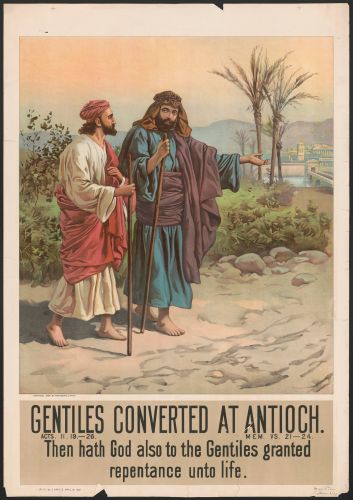
Proselytes, God-fearers, and Relations between Jews and Gentiles in the Bible

Gentiles converted at Antioch by Library of Congress is licensed under CC-CC0 1.0

By Mark D. Harris

Relations between Jews and Gentiles have been problematic for most of the history of the Jewish people.  Abraham seems to have been humble about his special relationship with God, and Isaac and Jacob as well.  They all seem to have integrated well into the world around them, while staying faithful to YHWH.  The Patriarchs, while flawed, knew the Lord, and were honored for it.

Slavery in Egypt was a defining period in the Jewish nation, and they understandably hated the Gentile Egyptians.  The Passover highlighted the distinctiveness of the Hebrews as God’s people, and on Mt. Sinai the tribes received the Law which separated them in many ways from those around.  Psychologically, such distinctiveness sometimes leads to short term feelings of inferiority and long term feelings of superiority.

Continue reading “Proselytes, God-fearers, and Relations between Jews and Gentiles in the Bible”

The Pharisees, the Sadducees, and the Essenes

By Mark D. Harris

The Pharisees, whose origin is probably in the “pious ones” or Hasidim, were a prominent religious group of at least 6,000 members in first century Palestine. After the catastrophe of the Babylonian exile and the growing threat of Hellenism during and after Alexander the Great, the Jews tried to recover what was right about their religion and culture and prevent anything similar from ever happening again.  They were dedicated to the Law, including the Torah, the Writings and the Prophets, and they believed that they should focus on three things.

  1. To know the Law expertly and judge wisely from it
  2. To make disciples
  3. To build a fence around the Law.

Continue reading “The Pharisees, the Sadducees, and the Essenes”

Daily Life in First Century Israel and the Roman Empire

How did the first century Jews live? What about the Romans? Get a glimpse of the daily experiences in first century Israel and Rome.

By Mark D. Harris

One of the difficulties in understanding the Bible as a 21st century American Christian is the vast chasm of language, culture, and geography that separates us from people of the Bible times.  Even considering only first century Palestine, the differences are enormous.  Nonetheless, the better we understand them, the better we will understand Him, and so studying daily life in that era is vital.

A typical day

First century Israel was first and foremost an agricultural society.  Lacking good ports, it could not be a maritime power and benefit from high levels of seaborne trade, but being on the Europe-Asia-Africa land bridge, Israel did benefit from overland trade.   Lacking natural resources such as iron, gold and precious stones, it could not make large amounts in exports.  So the average Jew was a farmer, holding a small plot of land and obeying the timeless rhythms of the seasons and the weather for his daily life.  The early Jew rose before the sun, dressed in a simple woolen or linen tunic and leather sandals, and tilled the fields for several hours before returning home for his morning meal of vegetables and bread.   His home was no more than a few rooms, with walls of stone and mud and a roof of beams/branches and mud.  After eating he returned to the fields, using hand tools and perhaps an ox.  Occasionally he went to market to buy the items needed for his farm and family.  After his toil, the New Testament Jew would return home to his wife and children for an evening meal, a little teaching of the Scriptures and perhaps singing and dancing, and an early bedtime.  The man’s neighbors in the same village, or perhaps even sharing the same courtyard, had similar schedules.  Taxes were exorbitant, up to 50% of a farmer’s salary, and the cause of financial destitution in many and brigandry in some.

Continue reading “Daily Life in First Century Israel and the Roman Empire”