Hellenization After Alexander – What was it, and Why Did it Matter?

Hellenization

Alexander the Great did far more than conquer the Middle East and large swaths of Central Asia. He spread Greek thought, customs, and culture into every place he went. Hellenization, making cultures more Greek, was anathema in Judea. And yet, Greek and Hebrew cultures mixed to form the milieu of first century Israel.

By Mark D. Harris

When conquerors want to subdue a foe, they crush their armies. If they want to rule a conquered land, however, they must displace the culture of that land. Alexander the Great knew this, and as he wanted an empire that would outlive him, he needed to displace conquered cultures with his own. This was especially urgent to him due to the diversity of his empire, including Assyrians, Jews, Egyptians, Persians, Parthians, Armenians, and a host of others. Hellenism is Greek culture, and is the primary weapon, even more than his armies, that Alexander used to influence Middle Eastern and European history for millennia.

Continue reading “Hellenization After Alexander – What was it, and Why Did it Matter?”

The Old Testament Prophets – What Did They Do?

Prophets seem strange to us, but they also seemed strange to their contemporaries. Who were they, and what did they do? What did the Old Testament prophets do?

By Mark D. Harris

Some Christians believe that the Old Testament (OT) prophets were men who predicted a distant future revealed to them by God.  Either the coming of Christ or the book of Revelation and the end times (or both) are seen as the main message of the Old Testament prophet.  Some critical scholars in the past have seen OT prophecy as unique or even fictitious; their messages brand new without any connection to Israel’s past and with no relevance for the future.  In reality, the primary mission of the prophets was to proclaim God’s truth to the people of their time and place, just like pastors and teachers today are called to do.

Continue reading “The Old Testament Prophets – What Did They Do?”

The Intertestamental Period – Where Do We Get Our Knowledge?

Intertestamental period

About 400 years elapsed between the end of Malachi and the beginning of Matthew. Called the intertestamental period, this time set the stage for the Roman Empire and the coming of Christ.

By Mark D. Harris

Knowledge is important in all fields, but it derives from different sources.  One can know science by observation and experimentation since physical phenomena are perceivable by the senses and repeatable.  Historical events, however, are not repeatable, and so persons of later eras must rely on written records and on artifacts from earlier eras if they wish to understand them. The best understanding usually comes from a combination of sources.[1]

Continue reading “The Intertestamental Period – Where Do We Get Our Knowledge?”

Tensions Between Rome and the Jews During the Early 1st Century AD

One of the recurring themes of the Roman Empire in the first century AD is the friction between the Jewish people and the Romans.  Much of stemmed from the dramatic cultural difference between the Romans who adopted Greek culture and the Jews, some of whom adopted Greek culture but most of whom held tightly to their Hebrew traditions.  The reign of the Seleucid Emperor Antiochus Epiphanes (175-164 BC) and the revolt of the Maccabees set an unbridgeable chasm between the two.

There were other reasons for the Jewish-Roman friction as well:

Continue reading “Tensions Between Rome and the Jews During the Early 1st Century AD”

Proselytes, God-fearers, and Relations between Jews and Gentiles in the Bible

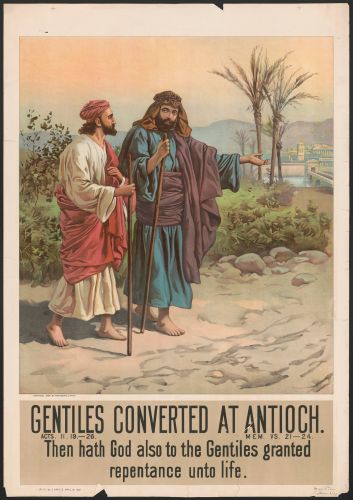
Gentiles converted at Antioch by Library of Congress is licensed under CC-CC0 1.0

By Mark D. Harris

Relations between Jews and Gentiles have been problematic for most of the history of the Jewish people.  Abraham seems to have been humble about his special relationship with God, and Isaac and Jacob as well.  They all seem to have integrated well into the world around them, while staying faithful to YHWH.  The Patriarchs, while flawed, knew the Lord, and were honored for it.

Slavery in Egypt was a defining period in the Jewish nation, and they understandably hated the Gentile Egyptians.  The Passover highlighted the distinctiveness of the Hebrews as God’s people, and on Mt. Sinai the tribes received the Law which separated them in many ways from those around.  Psychologically, such distinctiveness sometimes leads to short term feelings of inferiority and long term feelings of superiority.

Continue reading “Proselytes, God-fearers, and Relations between Jews and Gentiles in the Bible”

Daily Life in First Century Israel and the Roman Empire

How did the first century Jews live? What about the Romans? Get a glimpse of the daily experiences in first century Israel and Rome.

By Mark D. Harris

One of the difficulties in understanding the Bible as a 21st century American Christian is the vast chasm of language, culture, and geography that separates us from people of the Bible times.  Even considering only first century Palestine, the differences are enormous.  Nonetheless, the better we understand them, the better we will understand Him, and so studying daily life in that era is vital.

A typical day

First century Israel was first and foremost an agricultural society.  Lacking good ports, it could not be a maritime power and benefit from high levels of seaborne trade, but being on the Europe-Asia-Africa land bridge, Israel did benefit from overland trade.   Lacking natural resources such as iron, gold and precious stones, it could not make large amounts in exports.  So the average Jew was a farmer, holding a small plot of land and obeying the timeless rhythms of the seasons and the weather for his daily life.  The early Jew rose before the sun, dressed in a simple woolen or linen tunic and leather sandals, and tilled the fields for several hours before returning home for his morning meal of vegetables and bread.   His home was no more than a few rooms, with walls of stone and mud and a roof of beams/branches and mud.  After eating he returned to the fields, using hand tools and perhaps an ox.  Occasionally he went to market to buy the items needed for his farm and family.  After his toil, the New Testament Jew would return home to his wife and children for an evening meal, a little teaching of the Scriptures and perhaps singing and dancing, and an early bedtime.  The man’s neighbors in the same village, or perhaps even sharing the same courtyard, had similar schedules.  Taxes were exorbitant, up to 50% of a farmer’s salary, and the cause of financial destitution in many and brigandry in some.

Continue reading “Daily Life in First Century Israel and the Roman Empire”